
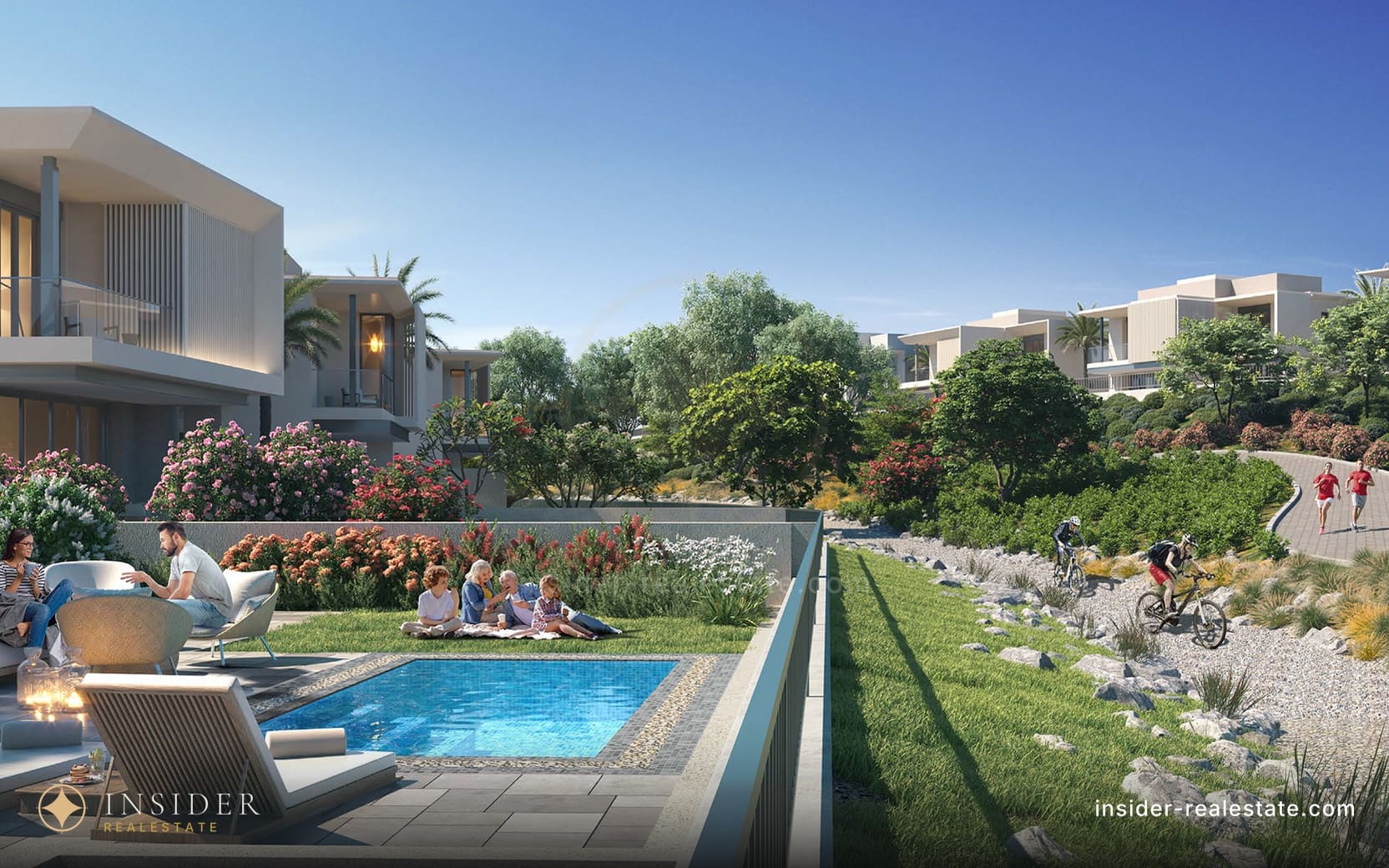
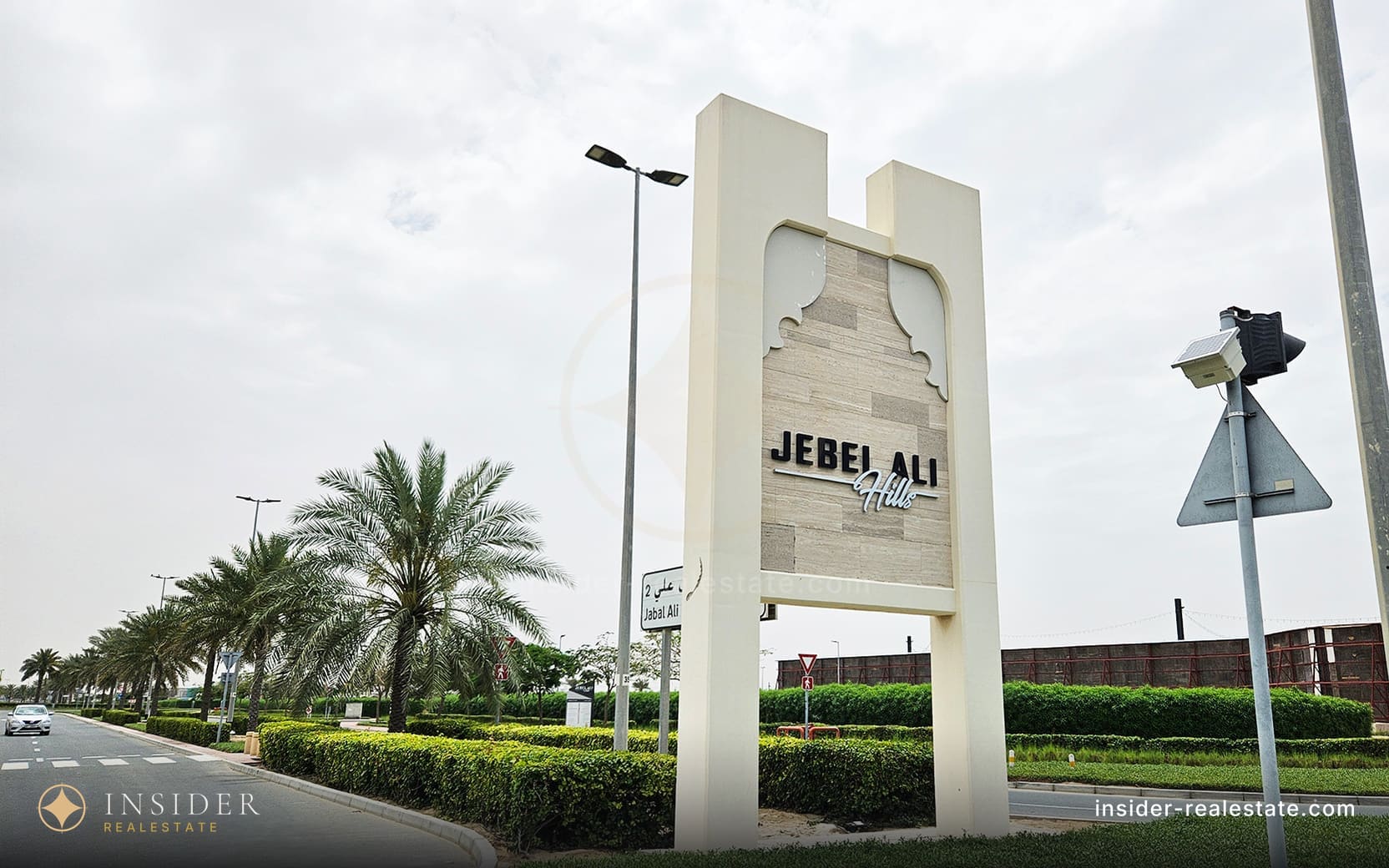
 −10% Photo of the community
 Jebel Ali
Port, free zone and industrial heartland — plus a small residential component serving the enormous local workforce.
15 units in stock. 14 with a confirmed status: 9 ready, 5 under construction. 20th most expensive of 80 districts by median price.
- workforce rental demand
- industrial and warehouse investment
- proximity to the port and free zone
Median price $1.58M AED 5 799 999
Entry price $252K AED 925 000 — cheapest unit
Per square foot $668 AED 2 452 / sq ft, median
Ready stock 64% 11 units discounted, up to −10%
What is nearby, and what it does to the price
What this area is actually like
What Jebel Ali is
Jebel Ali is the industrial and logistics heart of Dubai: the region’s largest container port, the Jebel Ali Free Zone (JAFZA) with thousands of companies, and a vast industrial and warehousing hinterland.
Residential development is a secondary function here. What exists — Jebel Ali Village, the Downtown Jebel Ali towers along Sheikh Zayed Road, and staff accommodation — serves the workforce rather than a general market.
The economic scale is the point: JAFZA and the port account for a very large share of Dubai’s trade activity and employ an enormous number of people.
The residential offer
Jebel Ali Village is an older low-rise residential community that has been partially redeveloped by Nakheel with new townhouse product, and it is the most conventional housing in the area.
The Downtown Jebel Ali towers on the Sheikh Zayed Road frontage are apartment buildings serving free-zone professionals, at affordable price points.
Beyond that, much of the residential stock in the area is workforce accommodation rather than open-market housing.
Who rents here
Free-zone and port employees, logistics and industrial staff, and professionals working in the southern corridor who want to avoid a long commute.
That base is large and stable, tied to an economic activity that is not going anywhere.
It is also specific: this is not a district that attracts tenants from elsewhere in the city. Demand is local employment demand.
The commercial angle
For an investor prepared to look beyond residential, the Jebel Ali industrial and warehousing market is one of the largest and most active in the region, with genuine tenant demand from logistics, trading and manufacturing businesses.
That market has different mechanics: long leases, tenant fit-out, low churn and attractive yields, offset by lower liquidity and the need to understand permitted use, power supply and loading access.
It is a specialist market and it rewards specialist knowledge.
What to check
Whether the specific property is in a designated freehold area open to foreign ownership.
Proximity to industrial activity and the associated traffic, noise and air quality.
The realistic tenant profile for the specific building.
For commercial: permitted activities, power capacity, ceiling height and loading access.
Access routes and how they behave during port and free-zone shift changes.
Who it suits
An investor targeting the workforce rental market with a clear understanding of who the tenant is.
A commercial or industrial investor who understands the warehousing market.
It suits poorly a general residential investor looking for a broad tenant pool, and anyone wanting a residential environment — this is a working district first.
Jebel Ali Village and the redevelopment
Jebel Ali Village is the oldest residential settlement in the area, built in the 1970s for port and industrial staff and for decades one of the greenest, lowest-density places in Dubai — single-storey houses under mature trees, on plots that would be unthinkable today.
Nakheel has redeveloped much of it, replacing the original housing with contemporary townhouses while retaining the tree cover and the low-rise character. The result is a gated community with a genuinely unusual amount of mature landscaping for new-build Dubai.
That combination — new houses, old trees, freehold, and a location minutes from the free zone — is the most conventional residential proposition in the whole Jebel Ali area, and it prices accordingly.
For a buyer it is worth distinguishing clearly between the redeveloped community and the surrounding older stock. They are different products with different ownership positions and different resale markets.
The workforce accommodation market
A large share of the residential building stock around Jebel Ali is purpose-built staff accommodation serving the port, the free zone and the industrial hinterland. It is a real asset class with real returns, and it is not something a general residential investor should wander into.
The regulatory position is specific: labour accommodation is licensed, inspected and subject to occupancy standards, and the operating model is closer to facilities management than to letting an apartment.
Yields can be strong and demand is tied directly to industrial employment, which in Jebel Ali is enormous and stable. But liquidity is thin, the buyer pool is specialist, and financing is harder.
If a listing in this area looks unusually cheap per square foot, establish what it actually is before going further. Ordinary residential and staff accommodation are frequently advertised in the same search results.
What the port and free zone mean long term
Jebel Ali Port is the largest container facility in the region and JAFZA hosts thousands of companies. Between them they anchor a share of Dubai’s economy that is not going to relocate, and that makes the local rental demand about as structurally secure as anything in the emirate.
The corridor is also where Dubai keeps investing: the Route 2020 metro extension, the Expo City build-out and the Dubai South aviation programme all sit within a short drive.
What that does not do is create scarcity. There is a great deal of land in this corridor and supply responds quickly, so the return here comes from rent rather than from appreciation.
Buy it as an income asset tied to an employment base you understand, confirm the freehold designation for the specific property, and be clear whether you are buying ordinary residential or something more specialised.
More on Jebel Ali
Written breakdowns of subjects the English channel has not filmed.
- The Jebel Ali coast: Dubai's last big stretch of undeveloped shoreline
The northern coast is effectively full. The 2040 plan turns the southern shoreline — including a revived Palm Jebel Ali — into the city's next recreational frontier. What that means for buyers, and what it costs to be early.
The market, per the Land Department
Residential price index 167.33 Q4 2025
Quarter on quarter +3.32% QoQ
Year on year +8.9% YoY
Full year 2025 +9.81% index 162.51
This is the official index for the whole emirate, not for Jebel Ali: the Dubai Land Department does not publish a district breakdown publicly. Treat it as background — it tells you whether the market is rising or flat while you read the prices above. Transaction data for a specific building I pull separately, on request. Source: Dubai Land Department, read 15/08/2026.
The latest read: July 2026
The Land Department index above is quarterly and emirate-wide. The monthly price index splits villas from apartments — and in 2026 that matters: a single blended figure hides the fact that the two markets have pulled apart.
Villas and townhouses 292.5 flat YoY
Apartments 168.7 −4.2% YoY
All residential 219.2 −0.3% MoM
Price per sqft 2 039 villas · apartments 1 397 AED
What this means for Jebel Ali
- 5% of off-plan deals landed in this district — out of 9 475 registrations for the month. Nearly all of it came from a single cluster — Jebel Ali Industrial Second. Off-plan district share is usually one large project rather than the whole area.
By completion status the month broke down as 72.8% off-plan and 27.2% ready. Ready-home deals grew 11.4% month on month; off-plan was the one segment lower against both the previous month and the previous year (−45.3%). In practice: apartments and off-plan leave room to bargain, finished villas in settled communities far less. Index base is January 2021 = 100 — a villa reading of 292.5 means growth of 192.5% from that mark, not a premium over a 2021 peak. Monthly ValuStrat market review for July 2026, checked 24/08/2026.
Questions about Jebel Ali
Can foreigners buy property in Jebel Ali?
In designated freehold areas, yes — including parts of Jebel Ali Village and the Downtown Jebel Ali towers. Much of the wider area is industrial or leasehold, so confirm the designation for the specific property.
Other districts
All districts →Projects in Jebel Ali
All projects in Jebel Ali →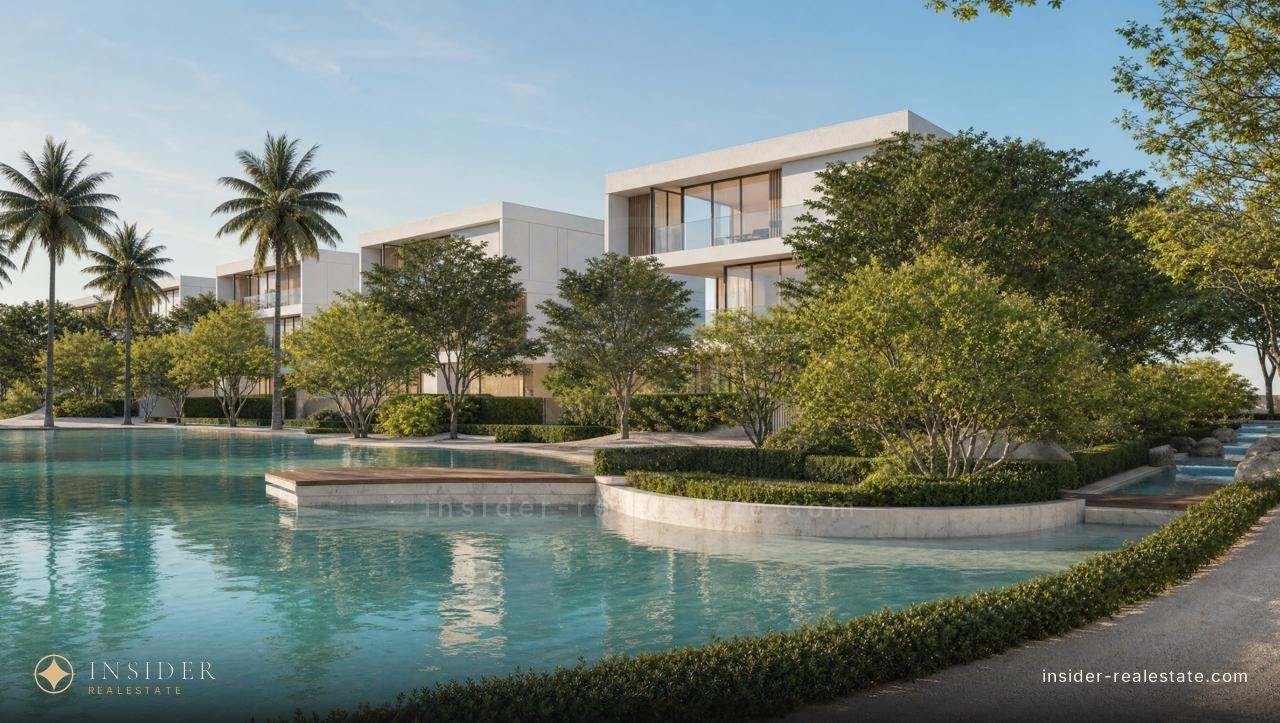
Jebel Ali in the news
UAE warehouses in 2026: a Grade A shortage, rising rents and who owns the market
Grade A warehouses in Dubai are close to full: JLL put occupancy in Jafza and Dubai Investments Park at 97–100% at the end of 2025, and industrial rents rose 6.8% year on year in Q2 2026 (5% in Abu Dhabi). Leases now run 7–9 years, not 3–5. Who owns the stock and what to check.
Dubai homes over $10 million: 500 sales in 2025 and a record 296 in the first half of 2026
Knight Frank counted 500 Dubai home sales above US$10m in 2025, worth US$9.05bn, against 30 in 2020. The first half of 2026 added 296 more worth US$5.1bn, a half-year record. Where the money went and why the top of the market held up.
Nakheel and Meydan inside Dubai Holding: what the 2024 merger changed for property buyers
In March 2024 Nakheel and Meydan were folded into Dubai Holding and their boards dissolved. By 2026 Palm Jebel Ali has 544 villas on Fronds A–F and 728 on K–P in finishing works, and 892 homes at Jebel Ali Village are being handed over. What changed for buyers, and what did not.
Palm Jebel Ali villas: the Beach and Coral Collections on Frond F — 44 homes by four architects
Nakheel has released 44 beachfront villas on Palm Jebel Ali’s Frond F: Beach Collection (5–6 beds, 7 500–8 500 sq ft) and Coral Collection (6–7 beds, up to 12 500 sq ft), ten designs by NAGA, SAOTA, LW Design and LOCI. 544 villas are under construction; the first mall, The Yard, opens in 2027.
Palm Jebel Ali villas: 544 homes under contract, The Yard retail hub and Select Group's arrival
Nakheel awarded AED 3.5bn of contracts for 544 Palm Jebel Ali villas due in Q4 2028; Dubai Retail is building The Yard, the island's first retail hub with 26 concepts, for 2027; and Select Group became the first private developer on the island. How a stalled project is turning into a district.
Jebel Ali Racecourse masterplan: BIG's 5 sq km district and where it stands in 2026
A.R.M. Holding and Bjarke Ingels Group are turning the Jebel Ali Racecourse into a 5 sq km district: eight neighbourhoods around a central park of about 1.5 sq km, with equestrian venues kept. Work was due to start in 2026; no price list yet. How it compares with Dubai Hills.
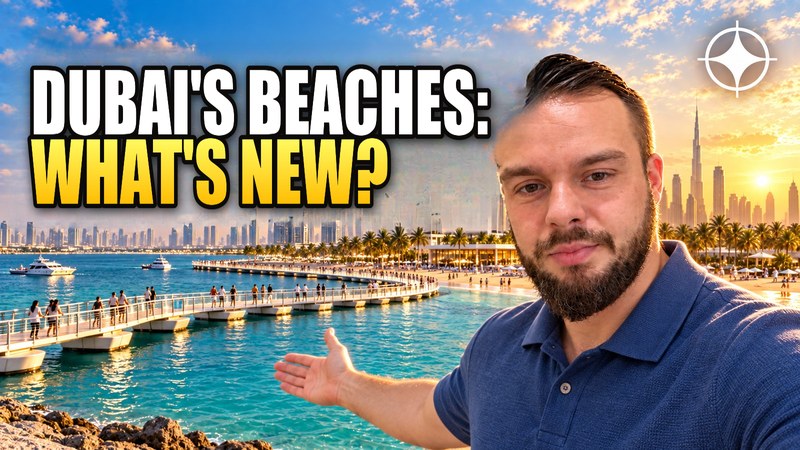
Al Mamzar floating bridge and Jebel Ali Beach: what Dubai has actually built on its coastline by 2026
Khor Al Mamzar Beach reopened in May 2026 after a AED 500m upgrade: the region's first floating pedestrian bridge, a 3.6km swimming line, a 300-metre night beach and 5.5km of trails. The Al Mamzar corniche is still finishing, while the 6.6km Jebel Ali Beach is being delivered in phases.
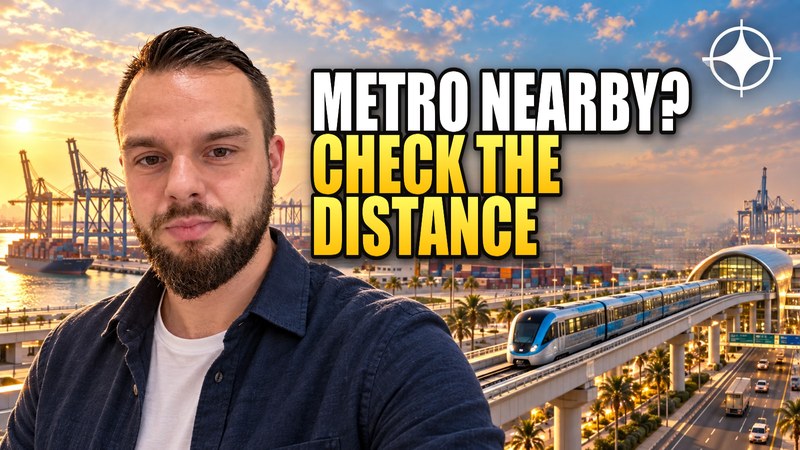
Jebel Ali: the transport corridor and what it means for housing — check the distance to the metro
A port, a free zone and residential clusters along the main highway and the metro line. Here what counts is not the district but the distance to a specific station.
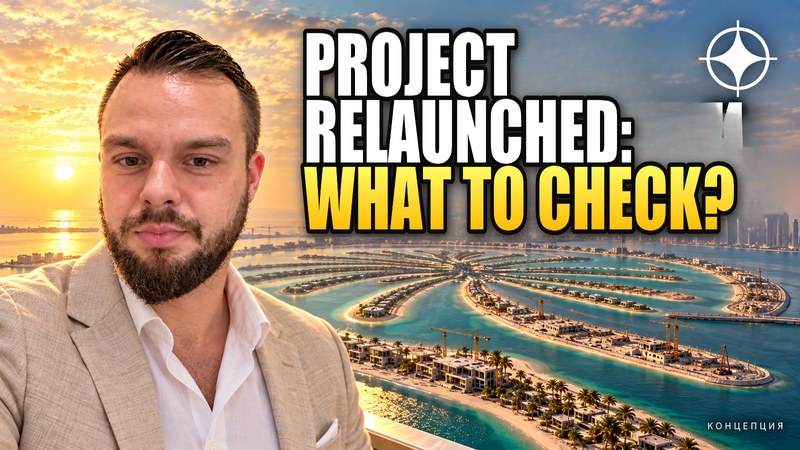
Palm Jebel Ali: buying into a relaunched project — what to check
The second palm island, reclaimed long ago and revived after a long pause. Relaunched projects come with their own set of questions.
Looking at Jebel Ali specifically?
Send me the building or the unit and I will pull the registered transaction history, the current service charge and what comparable units actually let for — before you make an offer, not after.
Ask on WhatsAppAsk a question
Telegram is the fastest way — I answer personally.
Message on Telegram