
Steel up 40%, concrete up 52%: what building actually costs Dubai developers now
“Prices cannot fall because construction is getting dearer” is heard constantly. The cost figures are real. The conclusion drawn from them is not — and the reason is that land, not materials, drove the market.
The argument that prices cannot fall because construction is getting more expensive is a fixture of the market. It deserves both halves of a proper treatment: the figures first, then the objection.
What has risen
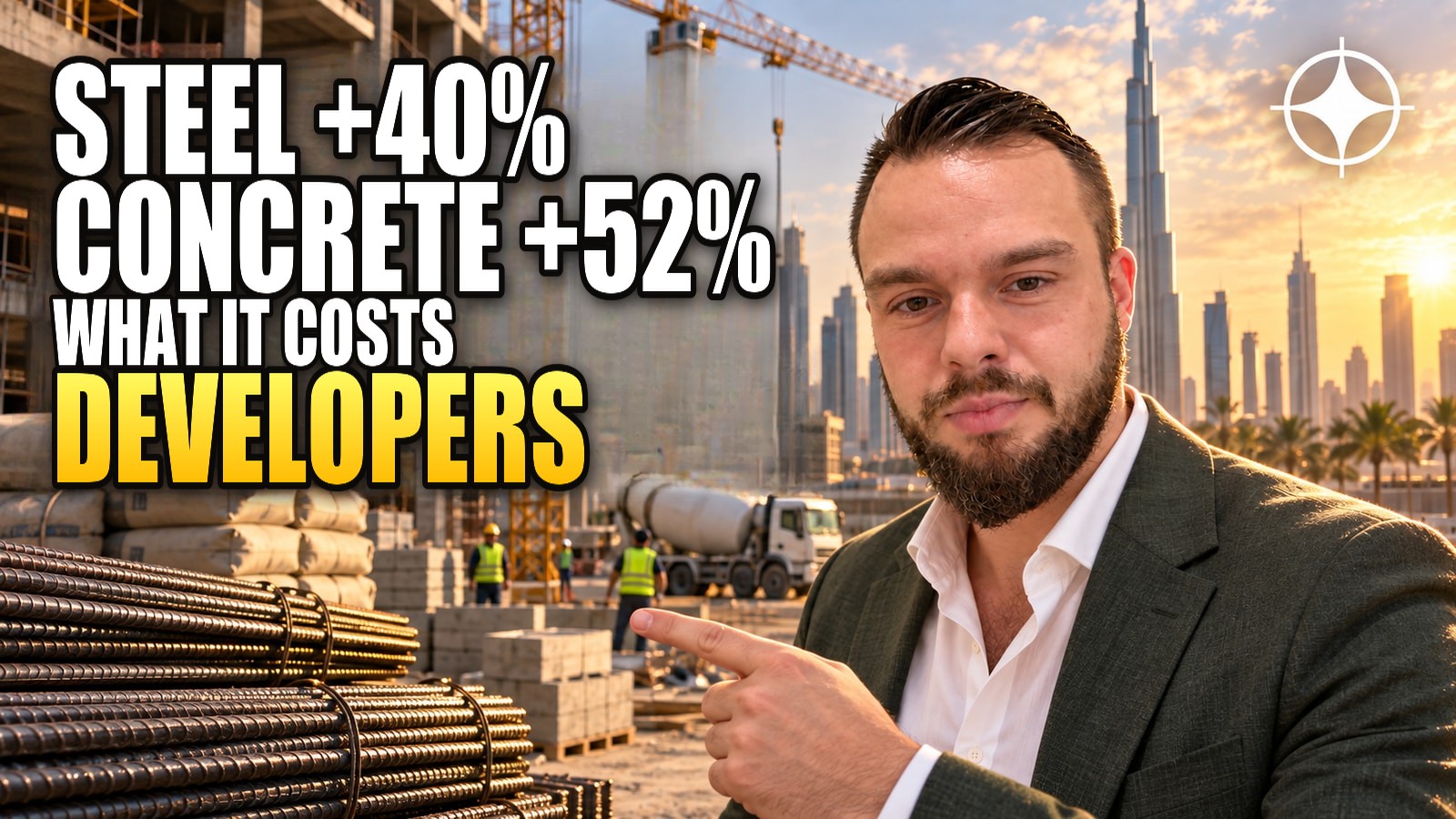
- Steel — from AED 2 150 to AED 3 000 a tonne, about +40%.
- Cement — +36%.
- Standard concrete — +52%; reinforced +46%.
- Concrete pumping — more than doubled, +127%.
- Hollow blocks — largely unchanged, about +5%.
The conclusion is straightforward: building has become significantly more expensive, and that pressure is not going away.
Why higher prices do not follow
Cost is one side of the equation. The other is demand, and it sets price no less firmly. Costs cannot be passed on indefinitely: when demand cools, a developer does not raise the list price — they hold sales together with discounts, payment plans and bonus packages. The list price stays; the effective price falls.
Talk to a licensed broker: 📲 +971 50 120 32 64 on WhatsApp, @dubai_oleg on Telegram
The second objection is more fundamental. What drove this market was land, not materials. In particular locations plots reached AED 600–700 per square foot, and land at that level moves a project's economics far more than a 40% move in steel. A developer who bought land cheaply years ago has room to absorb material inflation; one who bought at the peak does not, whatever happens to concrete.
What it does mean
Three things, all real.
- New launches price higher than existing stock. Not because the market moved, but because the cost base did. That widens the gap between off-plan and resale, and it is one reason to check a developer's price per foot against the district average.
- Marginal projects get shelved. Rising costs remove the weakest schemes from the pipeline, which supports supply discipline — one reason the office pipeline stays modest.
- Specification quietly falls. Under cost pressure the easiest saving is in what the buyer does not see at signing. Comparing the specification in the contract against the show unit is worth doing carefully in exactly this environment.
Video on this topic
The same subject on the English channel — each clip has a written version of its own.


In the news
Other write-ups on the site about the same thing.
Dubai property prices after 2008 and the pandemic: what history actually shows
Dubai prices fell roughly 45% in 2009 and barely dipped in 2020 — then both times the market recovered and pushed past old highs. We walk through both cycles with sourced numbers, and what that means for anyone timing a purchase in 2026.

Six of the twenty: Dubai is building a third of the world’s tallest towers
Six of the twenty tallest construction sites on the planet are in Dubai, and the whole UAE top ten is one city. What height means for a buyer is more prosaic than it sounds.

Twenty-fold in fifteen years: three record Dubai deals and what is behind them
Three transactions Dubai quotes as benchmarks. Looking at them together is more useful than at any of their percentages — and what they have in common is not repeatable.
Dubai cooled but did not crash: fewer transactions, prices holding
The change needs describing precisely, because headlines describe it wrongly. Price is what something sells for; liquidity is how long it takes to find the buyer.

A developer share index is not house prices: how not to confuse two markets
When the index falls, headlines turn it into “the Dubai property market is falling”. In some weeks of 2026 the index dropped 17% — and not one apartment moved by 17%.
Is Dubai property a bubble? What the UBS index says about Dubai, Frankfurt, Hong Kong and Singapore
The Swiss housing-bubble index places Dubai in fair-value territory: inflation-adjusted prices were still about a quarter below the 2014 peak, and rents grew faster than prices. How that compares with cities the index rates as overvalued.