
Lusail and The Pearl: how the Doha property market works
The law opened twenty-five zones to foreigners, but real liquidity and real turnover are concentrated in two of them. That is not a shortage of choice but a consequence of structure.
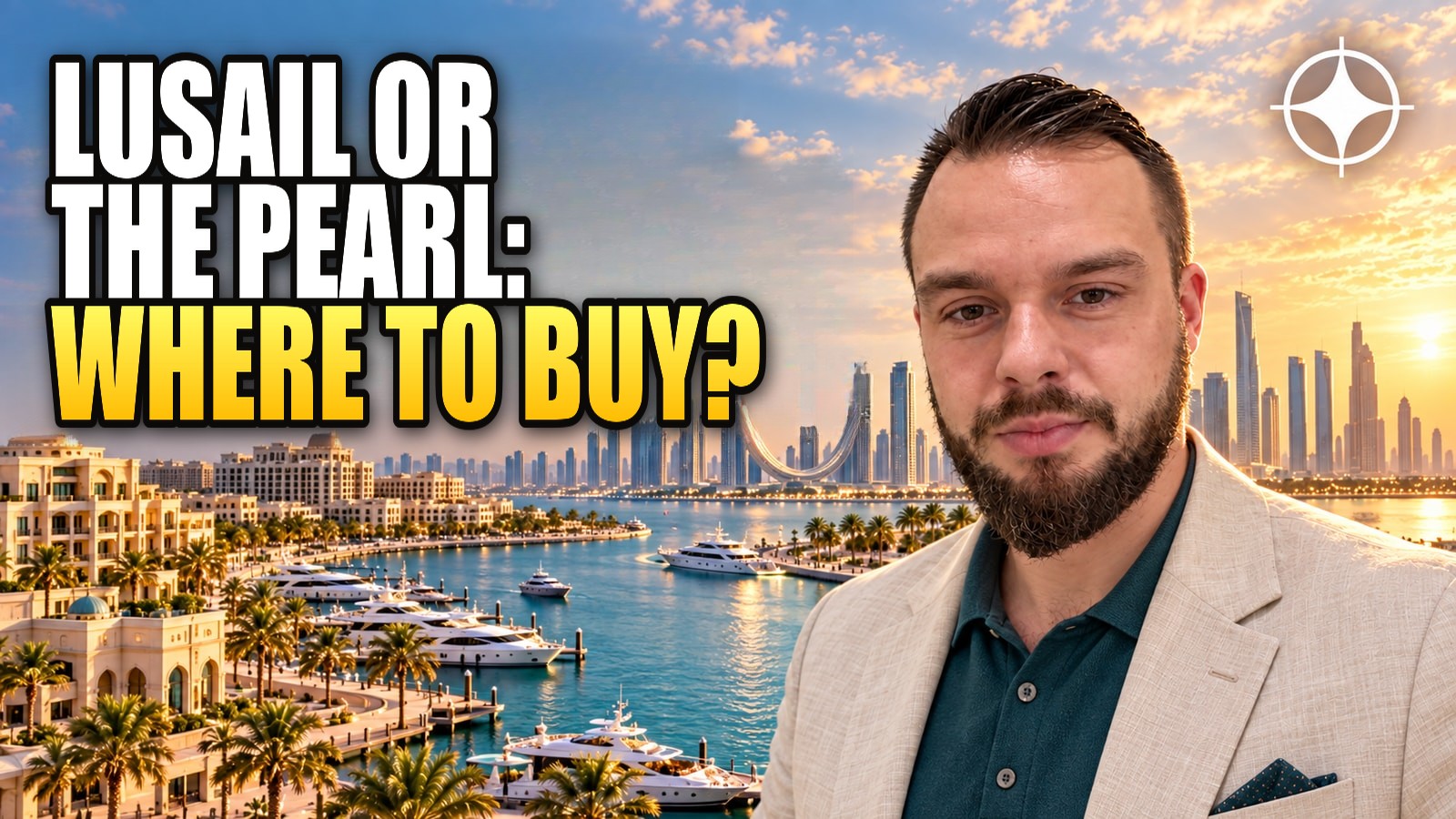
A conversation about investing in Qatari property almost always narrows to two addresses. That is not a shortage of choice but a consequence of how the market is built: the law opened twenty-five zones to foreigners, but real liquidity and real turnover are concentrated in two of them.
The Pearl — the island where it started
An artificial island off the west coast of Doha was the first address where a foreigner was allowed to buy at all. It was built as a self-sufficient quarter: marina, promenade, retail galleries, schools, restaurants — an environment you can live in without leaving. Hence its main property for an investor: the expat tenant comes here, and rental demand does not need creating.
- A finished market. Much of the stock was handed over long ago; you can view a property rather than buy from a render.
- A comprehensible rental history. The quarter has years of occupancy statistics — a rarity for the region.
- The age of the stock. The flip side: some blocks now need renewal, and the difference between a fresh and an older building inside one quarter is visible.
Lusail — a city built whole
Lusail north of Doha is not a quarter but a city designed and built from scratch: a business district of towers, a marina, a stadium, its own public transport. It was built for the World Cup and continues to be completed after it, and that defines its investment profile.
Talk to a licensed broker: 📲 +971 50 120 32 64 on WhatsApp, @dubai_oleg on Telegram
- Scale and newness. The infrastructure is more modern than anywhere else in the country and the layout does not inherit old Doha.
- Incompleteness as a factor. The city is populating gradually; a quarter that is full on paper can be half empty in life — and that shows in rent before it shows in price.
- A business function. Part of demand comes from companies relocating to the new business district — a different tenant from a resort island's.
Why the rest of Doha is nearly invisible to a buyer
Established quarters of the old city are open to a foreigner not as ownership but as a 99-year usage right. Legally that works; practically it narrows the pool of future buyers and complicates the exit: a fixed-term right sells worse than a perpetual one, and the discount for that is priced into the market. Beyond that, the housing stock there was built for a different demand, and the expat tenant a buyer is counting on goes there reluctantly.
How this market differs from Dubai's
- Depth. Transactions in Qatar are many times fewer than in Dubai, which translates directly into exit time: seasons, not weeks.
- Transparency. In Dubai a price is checked against the Land Department register; Doha has no such completeness of open data per transaction, and valuation rests more on opinion than on a sample.
- Composition of demand. The Dubai buyer pool is global; the Qatari one is markedly more regional, and the market is more sensitive to domestic decisions and to one or two large employers.
What that means for a buyer
Qatar is about status and the quality of the environment, not about a fast exit. A market with few transactions gives no liquidity however attractive the property. Completed against under construction is decided differently in the two quarters: on the island it makes sense to look at finished stock with a history, in the new city to work out who moves in next door and when. And check the form of right before anything else — a fine address on the usufruct list is not the same thing as a fine address on the freehold list.
Video on this topic
The same subject on the English channel — each clip has a written version of its own.
 4:15Lamborghini villas in Meydan: half the price of Ellington, and why26 January 2024
 13:04The best townhouses in Dubai under USD 600 000: Nshama Town Square7 October 2023
 13:00Socio by Emaar in Dubai Hills: buying a whole floor, and skipping the 2% commission4 October 2023
 12:00XXII Carat on Palm Jumeirah: 22 Mediterranean villas compared with Raffles and Zabeel Saray20 September 2023
In the news
Other write-ups on the site about the same thing.

Renting in Doha: who rents, what they pay, and why the market rests on expats
The easiest way into the Doha rental market is one figure: the overwhelming majority of Qatar’s population are foreigners who came to work. Demand is employment-driven, not domestic.
Taxes and fees in Qatar on a property purchase: what does not exist and what is paid
Qatar belongs to a small group of countries where the list of taxes on a private owner is almost empty. That is true, and it is also the main trap.
Property in Qatar: nine freehold zones and sixteen with 99-year usufruct
Before 2018 a foreigner could buy at exactly three addresses. The law rewrote the rules and split the country into three parts — and which part a house is in is the first question.

Bali districts: Canggu, Ubud, Uluwatu and Sanur — four different markets
Bali is sold as one place, but the island long ago split into several markets with different economics. A villa in Canggu and one in Ubud are different businesses.
Budva, Tivat and Kotor: three different property markets in Montenegro
The coast runs about three hundred kilometres, but a foreign buyer almost always chooses between three points — and the markets differ enough that a calculation does not transfer.
Qatar or Dubai: two Gulf property markets compared for a foreign buyer
Where a foreigner can buy more easily, sell faster, see clearer data and get residency for less. Qatar and Dubai compared on the seven points where they genuinely differ.