
Stargate UAE: a 1 GW AI cluster in Abu Dhabi, and what it actually means for property
The first 200 MW goes live in 2026 and the wider campus is planned at 5 gigawatts across ten square miles. Where the effect on housing and offices is real, and where it is being overstated.
Stargate UAE is a one-gigawatt compute cluster under construction in Abu Dhabi — the first international deployment of the Stargate AI infrastructure platform. Opinions on what it does to UAE property range from "nothing changes" to "prices double". Both are wrong, and it is more useful to take the thing apart.
What is being built
The cluster is built by G42 and operated by OpenAI and Oracle. Cisco covers networking and zero-trust security; SoftBank Group and NVIDIA are in the consortium, with NVIDIA supplying Grace Blackwell GB300 systems. The first 200 megawatts is expected online in 2026, with construction progressing to that schedule.
The cluster is part of something larger: the joint UAE–US AI campus spans roughly ten square miles and is designed for 5 gigawatts of data centre capacity — the biggest such deployment outside the United States. Power is mixed: nuclear, solar and gas. A science park is planned on the same site.
Talk to a licensed broker: 📲 +971 50 120 32 64 on WhatsApp, @dubai_oleg on Telegram
- 1 GW — the Stargate UAE cluster.
- 200 MW — first phase, live in 2026.
- 5 GW — designed capacity of the whole campus.
- ~10 sq miles — site area.
Where the property effect is overstated
A data centre is a poor driver of housing demand in itself. A gigawatt-scale cluster is staffed by hundreds rather than tens of thousands; construction employment is higher but temporary, and not the cohort that generates premium housing demand. "Property near a data centre appreciates" does not hold in its raw form — certainly not the way a new metro station or a school does.
Treat forecasts of AI's contribution to GDP with the same caution. Figures around $96bn and 13–14% of GDP by 2030 circulate widely; they are consultancy modelling produced before specific projects were announced. That is a scenario, not a fact, and it does not belong in an apartment's return calculation.
Where the effect is real
The mechanism runs not through the cluster but through what assembles around it.
- A company ecosystem. Access to compute is what makes technology companies open offices. That is demand for grade A office space in Abu Dhabi and the free zones, not for server halls.
- The profile of arrivals. Not rotational staff but engineers, researchers and executives with families. That is demand for schools, for housing in communities with infrastructure, for upper-mid rental.
- Institutions. The Mohamed bin Zayed University of Artificial Intelligence and the NYU campus in Abu Dhabi work as a continuous inflow channel for specialists. A university generates demand year-round; a data centre generates it once.
- Economic diversification. A technology sector is income not tied to the oil price. For a property market that means less dependence on the commodity cycle and a smaller amplitude of swings.
What changes for an investor
The main conclusion is not about specific locations but about the nature of growth. UAE property growth into the mid-2010s was substantially cyclical and speculative. Over the past decade the base has been duller and sturdier: population, jobs, infrastructure. Projects on the scale of Stargate feed that layer.
The horizon is correspondingly long. First phase in 2026, full campus years beyond. The effect on rents and capital values arrives as companies and people arrive around the site, not on the day of the announcement. Buying "for Stargate" expecting a repricing within a year is a bet on a headline rather than on an economy.
One risk to hold in view
The project has an external dependency: supply of high-performance chips to the region is subject to US export controls, and the schedule is discussed at a political level. That does not cancel the project, but it does mean dates can move. Any calculation resting on a precise commissioning date should carry that risk explicitly.
Video on this topic
The same subject on the English channel — each clip has a written version of its own.


Related reading
Other write-ups on the site about the same thing.
Abu Dhabi manages $1.7 trillion — more than Switzerland and the Netherlands combined
The number explains less than the structure does. There is no single pot: several independent institutions with separate mandates, and that arrangement is what makes the capital behave the way it does.
HELM Abu Dhabi longevity cluster: 30 000 jobs and $25.6bn of GDP by 2045 — what it means for housing demand
Abu Dhabi launched HELM, a life-sciences and longevity cluster based in Masdar City, in April 2025. Targets for 2045: $11.5bn of investment, 30 000 jobs and $25.6bn added to GDP. The first shared lab opened in 2026. Who it brings to the capital and where they will live.

Abu Dhabi for foreign buyers: investment zones, title and how it differs from Dubai
The capital runs its own register, its own zones and its own pace. What a foreigner may own there, how the market behaves differently, and why it is not simply a cheaper Dubai.
Abu Dhabi property market 2026: AED 117bn in six months and a run of ADREC records
ADREC data: AED 117bn of transactions in H1 2026 (+112%), AED 86.1bn of sales and AED 13.8bn of foreign direct investment (+309%, more than all of 2025). Full-year 2025 was a record AED 142bn. What sits behind the numbers.

Buy property in Abu Dhabi online: ADREC’s fully digital transaction, from contract to escrow
In October 2025 ADREC launched the Digital Buy & Sell Journey, the region’s first end-to-end online property transaction: mortgage release, registration, UAE Pass signatures, a trustee on video and settlement through ADREC-managed escrow. What it changes for a buyer abroad.
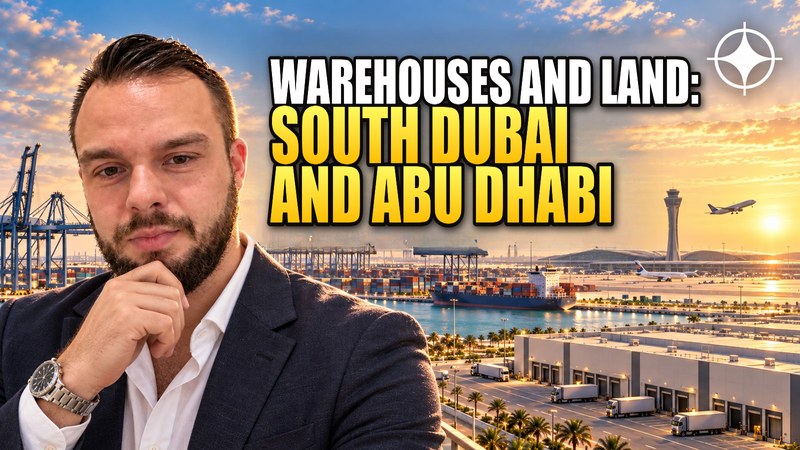
Warehouses and land: industrial property in southern Dubai and Abu Dhabi
Little is said about UAE industrial property, and yet it is a segment with clear economics and long tenants. What feeds it, and the three strategies people use.