
Abu Dhabi has frozen rent increases at 0%: what it changes for owners
From June 2026 the maximum permitted annual increase in the emirate is zero, replacing the 5% cap in force since 2016. A rare position for a tenant, and a direct constraint on a landlord’s model.
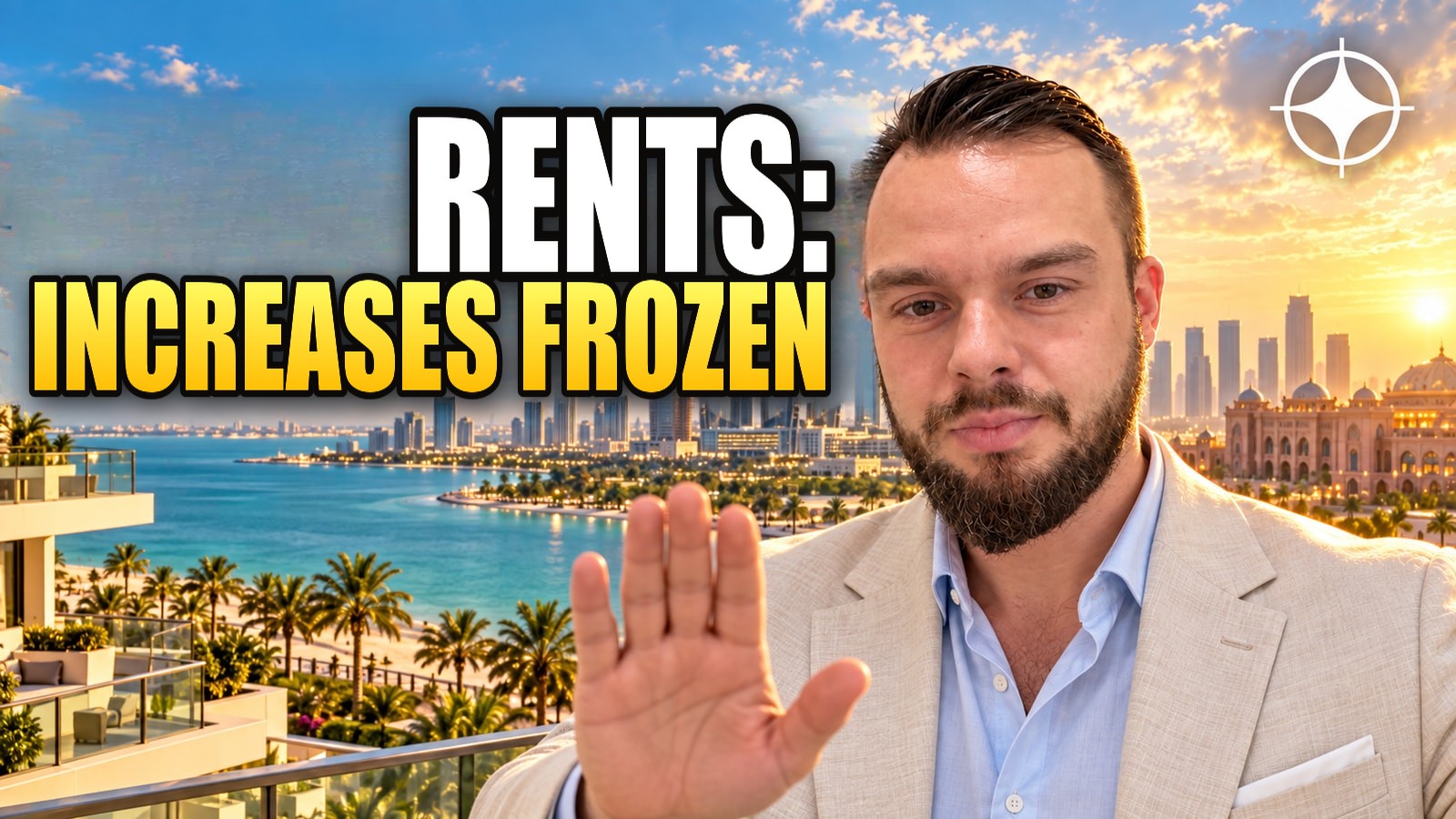
From 2 June 2026 the Abu Dhabi real estate regulator set the maximum permitted annual rent increase at 0%, replacing the 5% cap that had been in force since December 2016. In plain terms: a landlord cannot raise the rate at renewal at all.
What it means for a tenant
An unusually strong position. A tenancy renewed under this rule is a fixed housing cost, and in a market where apartment rents rose 12.5% year on year before the freeze, that is a substantial transfer of value to sitting tenants.
The caveat worth knowing: what is frozen is the rent, not every housing charge. Municipality fees, utilities and other billing continue to move, so the total monthly cost of a home can rise while the rent line does not.
Talk to a licensed broker: 📲 +971 50 120 32 64 on WhatsApp, @dubai_oleg on Telegram
What it means for an owner
A direct constraint on income growth, and it changes how a buy-to-let is modelled here. The standard Dubai approach — current rent plus an annual indexation assumption — does not apply. The model is built on today's rent held flat for the foreseeable term.
Two second-order effects follow. Turnover becomes more valuable to a landlord than tenure, because a new tenancy resets the rate to market while a renewal cannot. And the incentive to invest in the property shifts: improvements cannot be recovered through a rent rise on the existing tenant.
What it means for the market
Rent controls of this kind compress the spread between good and poor stock, because both are frozen at whatever they were let at. Over time that tends to reduce investment in maintenance, which is the standard critique of rent regulation everywhere.
It also, in the short term, makes the capital markedly cheaper to live in than Dubai for anyone already in a tenancy — which is itself a demand factor for the emirate, and a reason its rental market and Dubai's have decoupled.
The practical instruction
If you are buying to let in Abu Dhabi, obtain the current contracted rent on the unit rather than the market rate, because that is what you inherit. The difference between the two is the value of the constraint, and it is not visible in any yield figure quoted on a listing.
Video on this topic
The same subject on the English channel — each clip has a written version of its own.


Related reading
Other write-ups on the site about the same thing.

Abu Dhabi rent freeze: why Al Reem and Al Maryah are outside it
Since 2 June 2026 Abu Dhabi has cut the permitted annual rent rise from 5% to 0% for homes, offices and industrial units, until further notice — still in force in September. ADGM communities on Al Reem and Al Maryah islands are excluded and follow their own rules.

Abu Dhabi property market 2026: AED 117bn in six months and a run of ADREC records
ADREC data: AED 117bn of transactions in H1 2026 (+112%), AED 86.1bn of sales and AED 13.8bn of foreign direct investment (+309%, more than all of 2025). Full-year 2025 was a record AED 142bn. What sits behind the numbers.

Stargate UAE: a 1 GW AI cluster in Abu Dhabi, and what it actually means for property
The first 200 MW goes live in 2026 and the wider campus is planned at 5 gigawatts across ten square miles. Where the effect on housing and offices is real, and where it is being overstated.

Abu Dhabi for foreign buyers: investment zones, title and how it differs from Dubai
The capital runs its own register, its own zones and its own pace. What a foreigner may own there, how the market behaves differently, and why it is not simply a cheaper Dubai.

Abu Dhabi property market 2023–2024 review: AED 87bn, then AED 96bn, with Saadiyat in front
Abu Dhabi in 2023 and 2024, from ADREC: 22 751 transactions worth AED 87.1bn with sales value up 2.6 times, then 28 249 worth AED 96.2bn and foreign direct investment up 125% to AED 7.86bn. ValuStrat had Saadiyat villas up 19.9% in a year. Figures and the September 2026 status.

Sphere Abu Dhabi on Yas Island: the first venue outside the US to open by 2029
The roughly $1.7 billion project is going up on Yas Island between Yas Mall and SeaWorld. Capacity of up to 20 000 and a 16K Exosphere screen wrapping the whole building. What it changes for property on the island.