
Vincitore: ornate architecture in a cluster of identical boxes
A developer competing on decoration in Arjan and the mid-market districts. Where a distinctive facade genuinely helps, where it does not, and what to check underneath it.
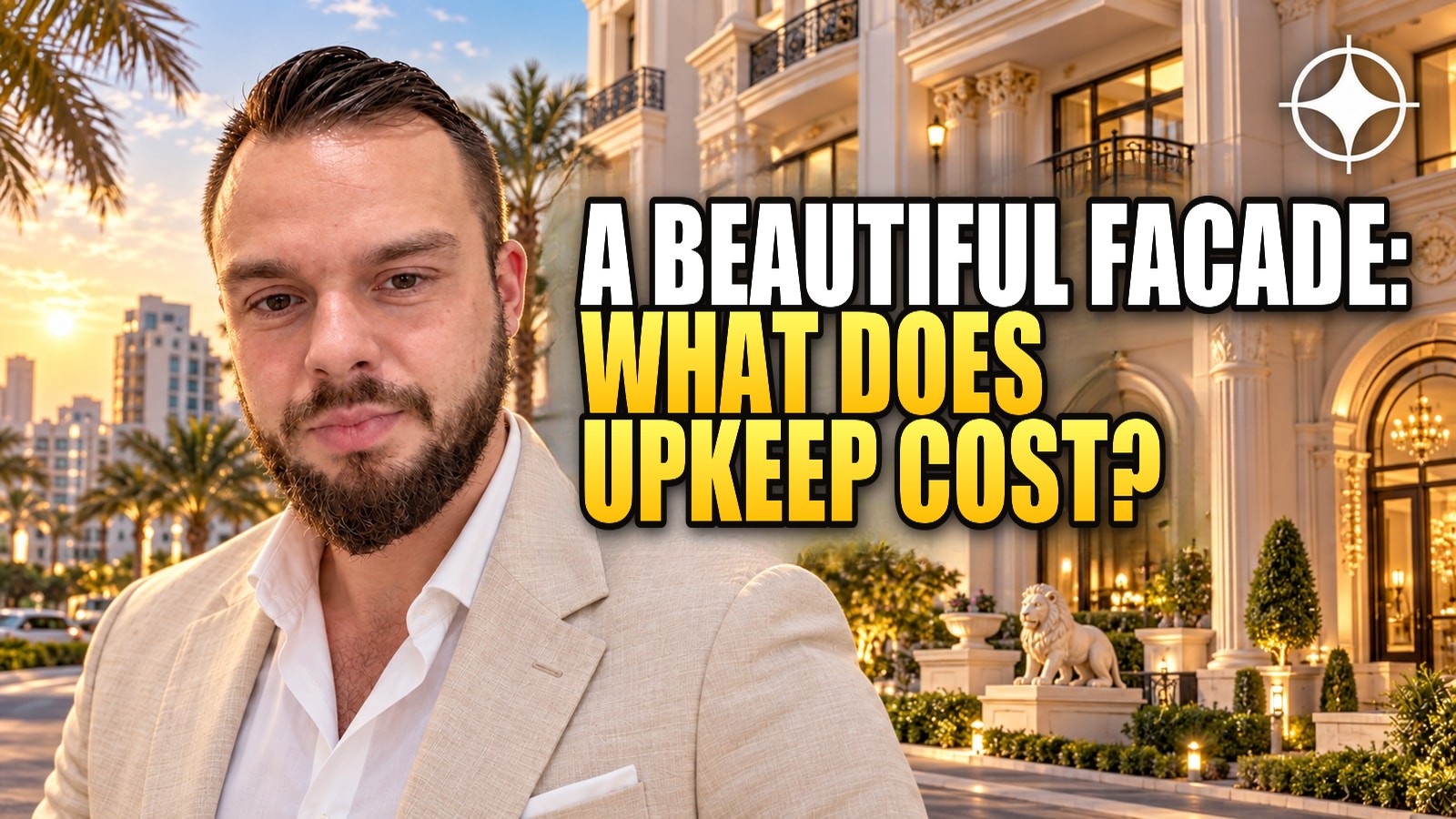
Vincitore builds in Arjan and comparable mid-market clusters, and it does so with elaborate classical-styled facades — columns, ornament, decorative detail — in districts where nearly everything else is a plain rectangle. The strategy is deliberate, and it is worth assessing on its merits.
Where a distinctive facade genuinely helps
- Short-let listings. A photograph that stands out in a search of two hundred near-identical studios converts into bookings. This is a measurable advantage, not a matter of taste.
- Recognition. A tenant or buyer can find the building, describe it, and remember it — which in an anonymous cluster has practical value.
- A marginally wider tenant pool among people choosing between otherwise interchangeable units.
Where it does not
- Long-let rent is set by the cluster. A tenant signing for a year prices location, size, condition and service charge. The facade adds little to that calculation.
- Resale is priced on comparables. Valuers work from square footage and district transactions; ornament is not a line in the valuation.
- Decoration has a maintenance cost. Detailed facades need cleaning and repair, and that reaches the service charge over the building's life.
- Taste is not universal. The same facade that attracts one buyer puts off another, which narrows rather than widens the resale market at the margin.
What to check underneath
The facade is the visible part; the purchase is everything else.
- Layout efficiency. Decorative envelopes sometimes cost usable internal area. Compare the floor plan against a plain building of the same headline size.
- The specification inside the flat, which is where the budget either went or did not.
- A delivered building by the same developer, a few years old — decorative finishes age faster than plain ones, and that is visible.
- Service charge in a comparable delivered building.
- Escrow, Oqood, the delay remedy and the contractor's record.
- Achieved rents in Arjan specifically, from live listings — the cluster is dense and competitive.
Who it suits
- Short-let investors, where visual distinctiveness does real work.
- Buyers who like the style and are buying somewhere to live.
- Not a buyer expecting the architecture to carry the resale price.
Based on the Dubai Land Department register and observation of the developer's delivered buildings.
Talk to a licensed broker: 📲 +971 50 120 32 64 on WhatsApp, @dubai_oleg on Telegram
Video on this topic
The same subject on the English channel — each clip has a written version of its own.
 1:38Binghatti Hills at Arjan: the volume play, examined10 September 2025
 19:45Oceano on Al Marjan Island: the Luxe Developers project and the island being built around it14 August 2026
 1:35Binghatti Aquarise, Business Bay: the pitch and the reality check12 September 2025
 1:17Skyrise by Binghatti: a landmark tower at mid-market pricing11 September 2025
 1:31Binghatti Haven in Dubai Sports City: cheap for a reason, or cheap for a good reason?9 September 2025

In the news
Other write-ups on the site about the same thing.
ORO24: rapid scaling in the mid-market, and how to price that risk
A developer that built a large pipeline quickly in Arjan and the growth clusters. What to verify when the pipeline is bigger than the delivery record.
Ellington Properties: what a boutique developer trades away
A company that builds few buildings and competes on architecture and floor plans. What the boutique format gives on quality and costs on liquidity, and what needs checking with a smaller developer.
Binghatti: a recognisable facade, a short build cycle, and what that costs
A family developer that became the second largest by project count in Dubai. The model behind the architecture — concentration in a few districts, fast delivery, branded collaborations — and what a buyer should check.
Dubai Islands: JW Marriott Residences by CG Developers, and Nakheel's AED 527m infrastructure contract
CG Developers is building Dubai's first JW Marriott residence, priced from AED 1.72 million with a Q1 2028 handover. In parallel, Nakheel has awarded a AED 527 million contract for Island B's core infrastructure — roads, water and sewage for a future 49 000 homes.
UAE developers under S&P and Moody's review: liquidity, construction costs and handover dates in 2026
In March 2026 S&P saw no liquidity pressure at Emaar, DAMAC, Omniyat and PNC Investments. In July Moody's reported most UAE projects due in 2026–27 on schedule despite imported materials costing 20–25% more. What off-plan buyers should take from both.
Dubai's top developers by 2025 sales, and the 648 projects launched in a single year
Emaar sold about AED 65.8bn in Dubai in 2025, DAMAC AED 35.9bn, Sobha about AED 30bn and Binghatti AED 26bn. Meanwhile 258 developers launched 648 projects with 167 000 units. What that mix of concentration and crowding means for buyers.