
The UAE car market: why half the region buys its cars here
A 5% import duty plus 5% VAT with no exceptions made the Emirates one of the world’s largest automotive hubs. A look at the market’s four layers: official dealers, pre-owned showrooms, government auctions and parts yards.
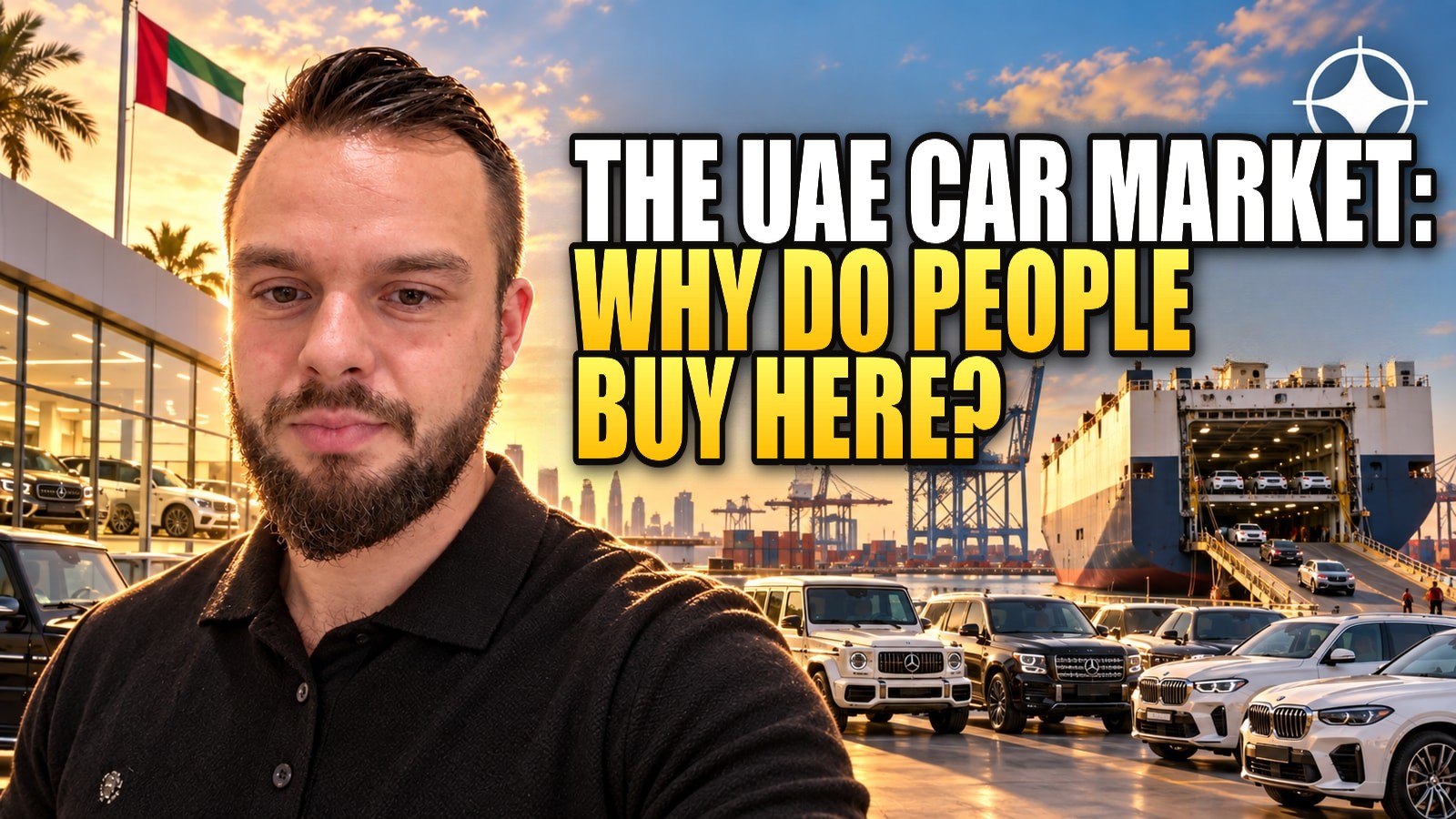
Dubai is not merely a place with a lot of expensive cars. It is one of the world's largest automotive hubs, and there is a straightforward economic reason for it.
It starts with taxes
The scheme is about as simple as they come: 5% import duty plus 5% VAT, on any goods, with no sectoral exceptions or special regimes. That is why cars are traded from here into Oman, across the Gulf and far beyond: the margin exists and the volume is enormous.
Compare that with jurisdictions where importing a car is taxed on a sliding scale by engine size, age and emissions class, and it becomes clear why the logistics settled the way they did.
Talk to a licensed broker: 📲 +971 50 120 32 64 on WhatsApp, @dubai_oleg on Telegram
Four layers of the market
- New cars through official dealers. A concentrated market: brand distribution has historically been divided among a small number of large groups. Chinese manufacturers have begun entering directly in recent years, gradually changing that picture.
- Pre-owned showrooms. Someone drives a car and trades it in; the showroom buys it outright or takes it on consignment. Prices are substantially lower and practically every brand is represented.
- Government auctions. Repossessions, cars abandoned at airports, confiscated vehicles — all go to auction. Entry is by paddle, with bid increments of AED 500–1 000 depending on lot value.
- Parts yards. A distinct industry, where components that cost a fortune at a dealer sit on a shelf for a fraction of the price.
What this has to do with property
Two connections, both practical.
First, cost of ownership. Dubai remains a car city despite the metro and the Dubai Walk programme. For most districts a car is not a luxury but a condition of ordinary life, and its cost belongs in a relocation budget alongside rent. It is markedly cheaper here than in Europe, which is worth knowing when modelling a move.
Second, parking as part of an asset's value. Since almost everyone has a car, a parking bay in a development stops being optional. An apartment with one bay for a two-car household creates a daily problem, and older buildings in central districts frequently lack spaces. This is a parameter to check in person, not in a listing description.
Based on UAE customs and tax data and the structure of its automotive market.
In the news
Other write-ups on the site about the same thing.
Dubai raises the duty-free threshold for online purchases from AED 300 to AED 1 000
The duty-free import threshold for e-commerce parcels in Dubai has more than tripled — from AED 300 to AED 1 000 (tobacco and alcohol excluded). Why the emirate keeps lowering trade friction, and what it signals about the logistics-hub strategy.

UAE economy in 2026: PMI at 55.3 in August, GDP up 3% and Dubai private schools in the PISA global top ten
The UAE non-oil PMI rose to 55.3 in August 2026, its highest since December 2024. Real GDP grew 3% in Q1, with the non-oil share at 79.4%. Dubai private schools ranked 6th in the world for reading and 8th for maths in PISA 2025. Why the economy looks stronger than the housing mood.
UAE Economic Stability: Second in the World, Behind Only Switzerland
An international stability study ranks the UAE second worldwide, ahead of Canada, Germany and Japan. GDP per capita rivals Western Europe, and the country’s sovereign wealth funds hold trillions of dirhams in assets.

Non-Oil Sector Now 74.6% of UAE GDP; Dubai Draws $14bn in Foreign Investment
The UAE’s non-oil economy has grown to 74.6% of GDP, up 4.5%. Dubai alone attracted $14bn in foreign direct investment — up 33% year on year — and a record 1 117 new greenfield projects.

Dubai Cracks the Top 7 Global Financial Centres: What It Means for Housing
Dubai climbed four places to rank 7th on the Global Financial Centres Index, its best result ever. At the same time, the UAE posted a record AED 177.3bn in foreign direct investment. How both feed through to apartment prices.

UAE salaries to rise by an average of 3.4% in 2026
Employers across the UAE are budgeting an average 3.4% pay rise for 2026 and shifting to flexible KPI-based bonuses. Why salary dynamics are the most underrated indicator for the housing rental market.