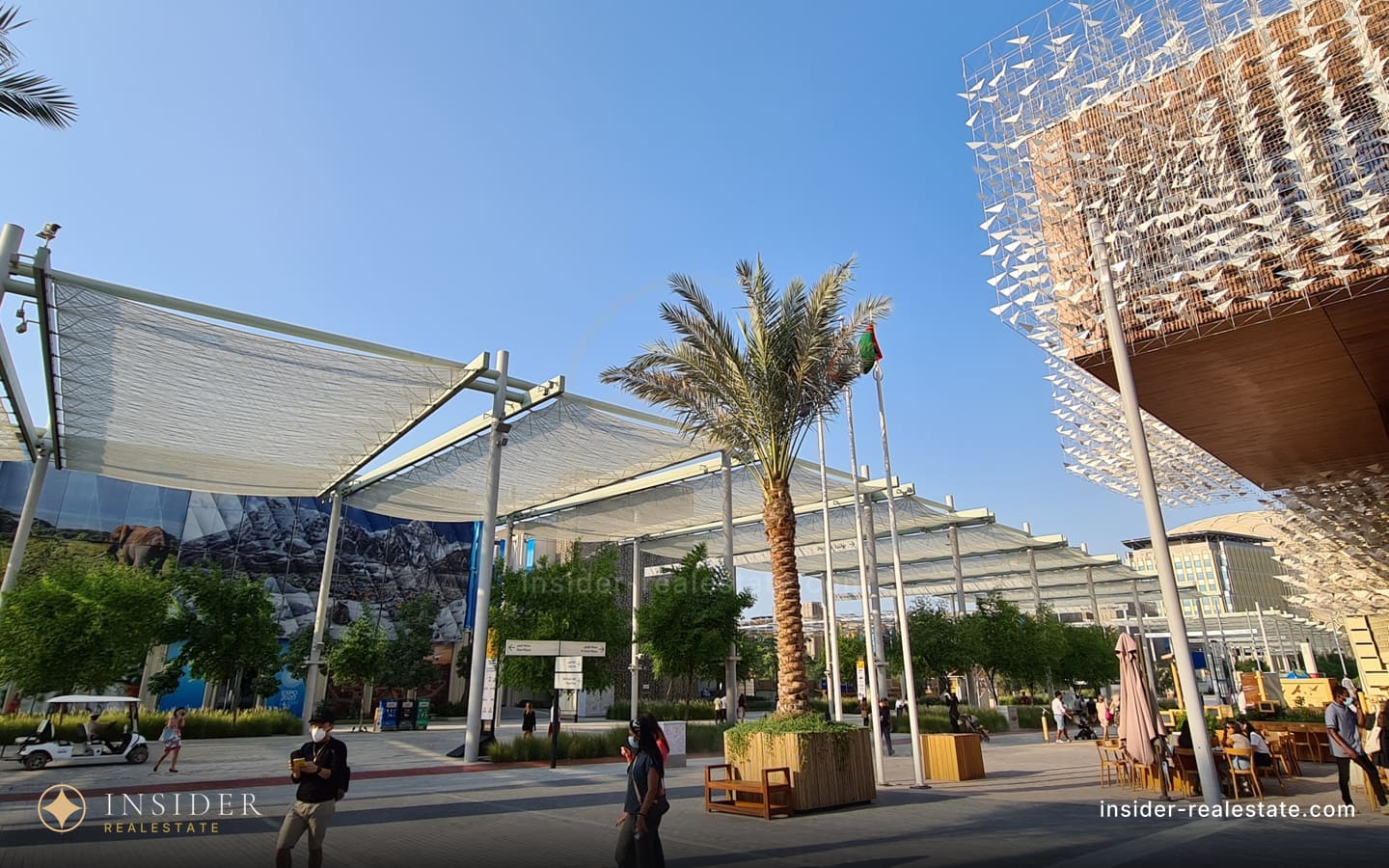
Expo City Dubai: living on the site of a world exposition
The master developer turning the World Expo site into a permanent district. What a legacy site starts with that a normal master plan does not — and the one question that decides it.
Expo City Dubai is the entity converting the World Expo site into a permanent mixed-use district. Legacy sites are an unusual category of development and they behave differently from a master plan started on empty land — better in some respects, and with one specific risk.
What a legacy site starts with
- Infrastructure already built to event standard. Roads, utilities, a metro connection and public realm were delivered for the exposition, not promised for phase four.
- Landmark architecture that exists. The pavilions and central structures are standing, and they are not renders.
- An unusually generous public realm — an exposition is designed around pedestrian movement, which is rare in a city built around cars.
- Institutional anchoring. Organisations and offices were placed on the site as part of the legacy programme.
Compared with a district that has to build all of that from nothing over ten years, that is a genuine head start, and it is the strongest argument for the location.
The one question that decides it
Does a place designed for visitors become a place where people live?
Talk to a licensed broker: 📲 +971 50 120 32 64 on WhatsApp, @dubai_oleg on Telegram
An exposition site is engineered for crowds that arrive, spend a day and leave. Permanent residential life needs different things: everyday retail rather than showcase retail, schools, clinics, and enough residents for a supermarket to be worth opening. That transition is the whole proposition, and it takes years to prove.
- Check what serves residents today, not what served visitors.
- Count occupied homes, because critical mass is what turns amenity on.
- Look at the office and institutional occupancy — weekday population is what supports everyday business.
What else to check
- Who developed your specific building. On a master-planned site the seller in your contract is often not the master developer, and your remedies belong to whoever signed.
- Both charges — building service charge and any community charge for the shared realm. Exposition-grade public space is expensive to maintain, and that cost has to land somewhere.
- Which phases remain and where, relative to your home.
- Achieved rents on site, from real listings.
- The commute, driven at peak — the site sits on the southern edge of the city.
- Escrow and Oqood on off-plan.
Who it suits
- Buyers who value walkability and public space and are willing to wait for everyday amenity to fill in.
- Long-horizon investors who accept a slower rental ramp in exchange for infrastructure that already exists.
- Not somebody who needs a mature neighbourhood on day one.
Based on the Dubai Land Department register and the published legacy programme for the site.
Video on this topic
The same subject on the English channel — each clip has a written version of its own.
 19:45
19:45 Oceano on Al Marjan Island: the Luxe Developers project and the island being built around it
A walkthrough of Al Marjan Island as it is being built: current infrastructure, the resort plots still under construction, and the architectural vision for the hotels going up around Oceano.
WatchIn the news
Other write-ups on the site about the same thing.
Expo City Dubai: what happened to the world exposition site
Exposition sites usually decay after closing — it is nearly a rule. Dubai converted its into a permanent district, and the reason it is growing is the opposite of the usual Dubai story: the infrastructure came first.
Dubai Sports City: what a themed district looks like fifteen years on
A master development built around sports venues and academies. Themed districts age in a specific way, and this one is old enough to show how — which makes it unusually easy to assess.
Meydan: a master developer whose land other developers build on
The company behind Meydan City and much of the district around it. Why the name on the master plan is often not the name on your building, and what each of them is responsible for.
Nakheel: the master developer of the islands, and what that title means
The state developer behind Palm Jumeirah and the Dubai Islands. The difference between a master developer and a building developer, and why it matters for what you own.
Al Warqaa: buying in a district nobody developed
Most of Dubai is somebody’s project, with a master plan and a community charge. Al Warqaa was built plot by plot, and that changes five practical things.
Cash in Dubai property deals: the AED 55 000 limit and what gets checked
In May 2024 two of Dubai’s biggest master developers, with 30–40% of sales by value, capped cash at AED 55 000 per deal — the rest by bank transfer. The same threshold triggers mandatory broker reports on cash and crypto-funded deals.
Below market in Expo City Dubai right now
From the daily off-market feed. Availability and price are confirmed on request.
All below-market listings →