
 −14%
−14% The Sustainable City The Sustainable City · 3 BR · Townhouse 4 200 000 AED 4 900 000
Ask about lot NP12-432913
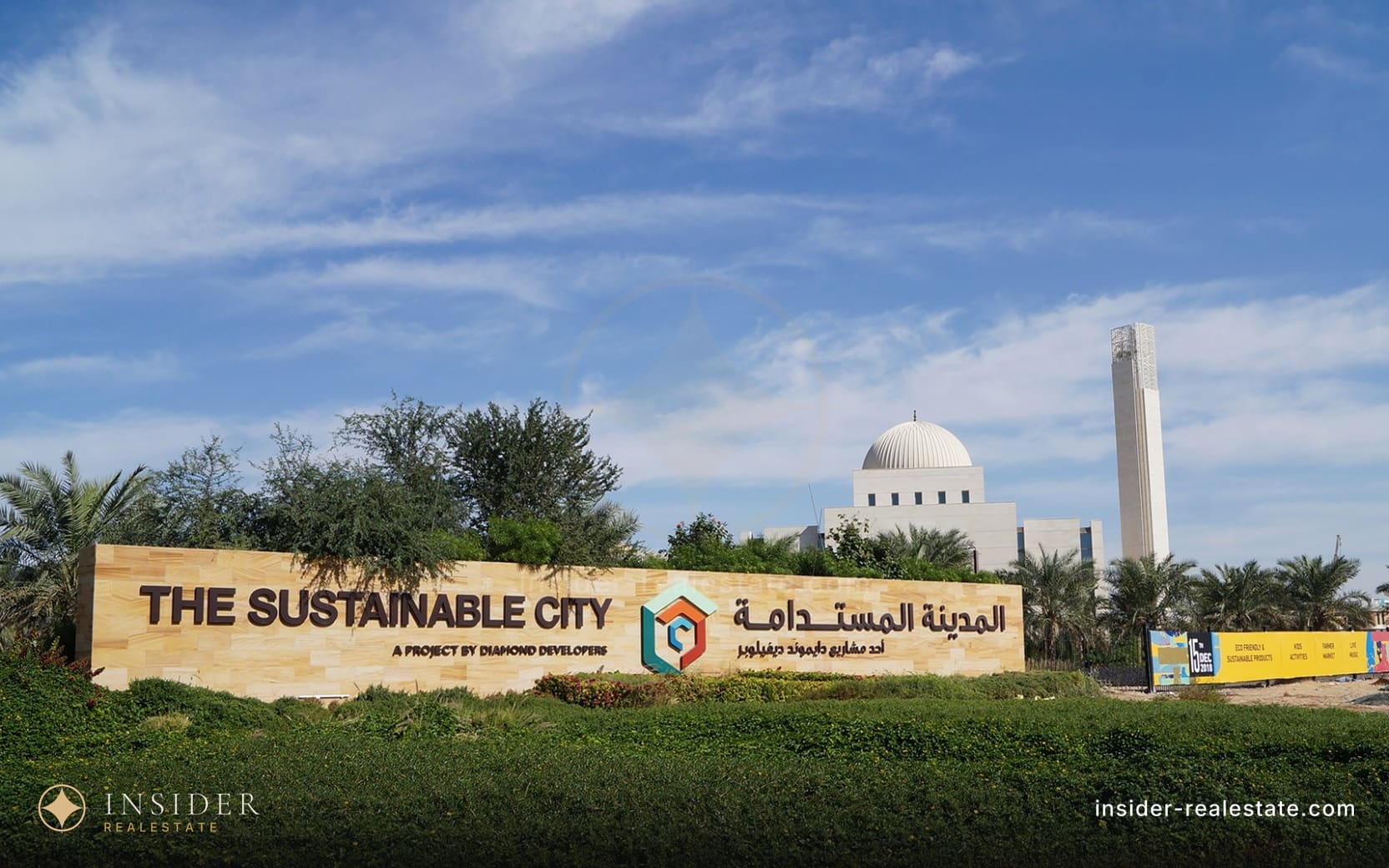
A developer that treats sustainability as an engineering specialty rather than a marketing word: The Sustainable City in Dubai became the emirate's first net-zero-energy residential district, and the company has built its reputation around that project for years.
9 lots in stock across 1 project. Of the 9 with a known status: 0 ready, 9 under construction. By median price — 38th of 139.
The districts where this developer has the most lots in our stock.
Checkable facts about the developer itself. Unlike the figures above, these are not about our stock and do not move with what happens to be listed today.
Diamond Developers was founded by a civil engineer, and that shows in how its flagship project is built: not a few green touches layered onto standard construction, but an integrated engineering system — solar generation, waste recycling, car-free internal streets, organic farms inside the residential district itself. On a Dubai market where 'eco' usually means a couple of trees in the courtyard and a LEED mention in the brochure, this is a rare case where the concept is implemented systematically rather than selectively.
The company is unusual on the local market for the depth of its specialisation: most developers add sustainability as one feature among several, while here it is the foundation the entire business model is built around, from materials to how internal traffic is organised.
Net-zero-energy status is not a marketing phrase but a measurable engineering result: the district generates as much or more energy than it consumes, through solar panels and energy-efficient building design. For an owner that translates directly into lower utility costs compared with a typical district of the same class — but the exact saving should be checked against current bills, not the general concept description used in sales material.
A second practical effect is the car-free internal streets: designing the district around pedestrian and bicycle routes rather than the car changes daily life more than it looks on paper. That is worth assessing in person on site rather than from a description — for some families it is the district's main appeal, for others an inconvenience if they are used to relying on a car.
The company did not stop at one residential district — a whole ecosystem has grown around it: an indoor tropical-forest attraction that has become a standalone tourist destination in the city, and a partnership with Aldar on Yas Island in Abu Dhabi, where the same sustainability concept is being replicated jointly with the capital's largest developer. That is a sign the model works not just as a showcase project but as a commercially repeatable formula.
International expansion — a sustainable project in Bahrain — points the same way: the company is not trying to prove the concept once and stop, but is building a repeatable business around it across jurisdictions. For an investor that is indirect but meaningful evidence of the business model's maturity beyond a single flagship site.
Most new Dubai projects in recent years have added language about sustainability, energy efficiency and green technology — it has become part of the standard marketing kit. The difference here is depth: Diamond Developers' sustainability claims have been tested by years of a completed, occupied district in actual use, not just stated at construction stage the way most competitors' still-unproven projects are.
That creates a situation rare for this market: a buyer can see the finished result of the concept before buying, rather than trusting a render and a brochure. It is worth using that — assess in person how the district looks and functions years after move-in, rather than stopping at a new project's presentation.
For the completed part of The Sustainable City, ask current owners for real utility bills rather than the marketing-stated savings figure — the gap between the advertised number and practice is itself informative on this type of project. For new phases or new group projects, check what stage of engineering-system rollout the specific phase is at, since not every element of the concept necessarily arrives together with building handover.
Separately, confirm the maintenance arrangements for solar panels and other specialised engineering systems — this can require different expertise from the management company than a standard building, and the service charge should be compared by what it covers, not just the final number.
−14% −14% −12% −7% −6% −6% −5% −4% −3% Lots are matched to Diamond Developers by project name, since the base has no developer field. The numbers above therefore describe our stock rather than the company’s market share: a developer with a large completed portfolio can show fewer lots than one whose buildings are resold more often.
All prices are asking prices, not sales. For the building you pick I pull the registered Land Department transactions and show the prices deals really closed at.
The median across this developer's lots in our stock is $1.14M (AED 4 200 000), with entry from $430K. These are asking prices out of our own base, recalculated every night; they follow what the developer and its sellers actually have on the market, not the price list on a corporate site.
Right now the base holds 9 lots from this developer priced below the market, with the deepest cut at 14%. The discount comes from the seller on a resale or an assignment, not from the developer: they have their own reason to exit quickly. The size of the cut is computed against comparable property by an algorithm, not typed in by a broker.
Founded: 2003, by founder and CEO Faris Saeed. A developer is checked against the Land Department’s open register rather than a brochure: it shows the licence status, the construction progress of each project and the registered escrow account. On off-plan the buyer’s money goes into that account under RERA supervision and is released against verified milestones. The full dossier is in the write-up above.
The price is the same: on off-plan the developer pays the broker’s commission, not the buyer, so going straight to the sales office saves nothing. The difference is elsewhere — a developer’s sales office shows its own projects only, and will not tell you that the same thing next door is cheaper or that this project is running later than advertised. On resale and assignment the commission is the standard 2% plus VAT.
It depends what you are buying and why. Send me your budget and the job it has to do — I will tell you which of this developer's projects make sense right now and which I would walk past.
Ask on WhatsAppTelegram is the fastest way — I answer personally.
Message on Telegram