
Abu Dhabi Corniche: The Capital’s Waterfront
Roughly eight kilometres of gardens, promenades, beaches and open Gulf views. How a working 1970s shoreline became one of Abu Dhabi’s main public spaces — and what a full day on Corniche Beach actually looks like.
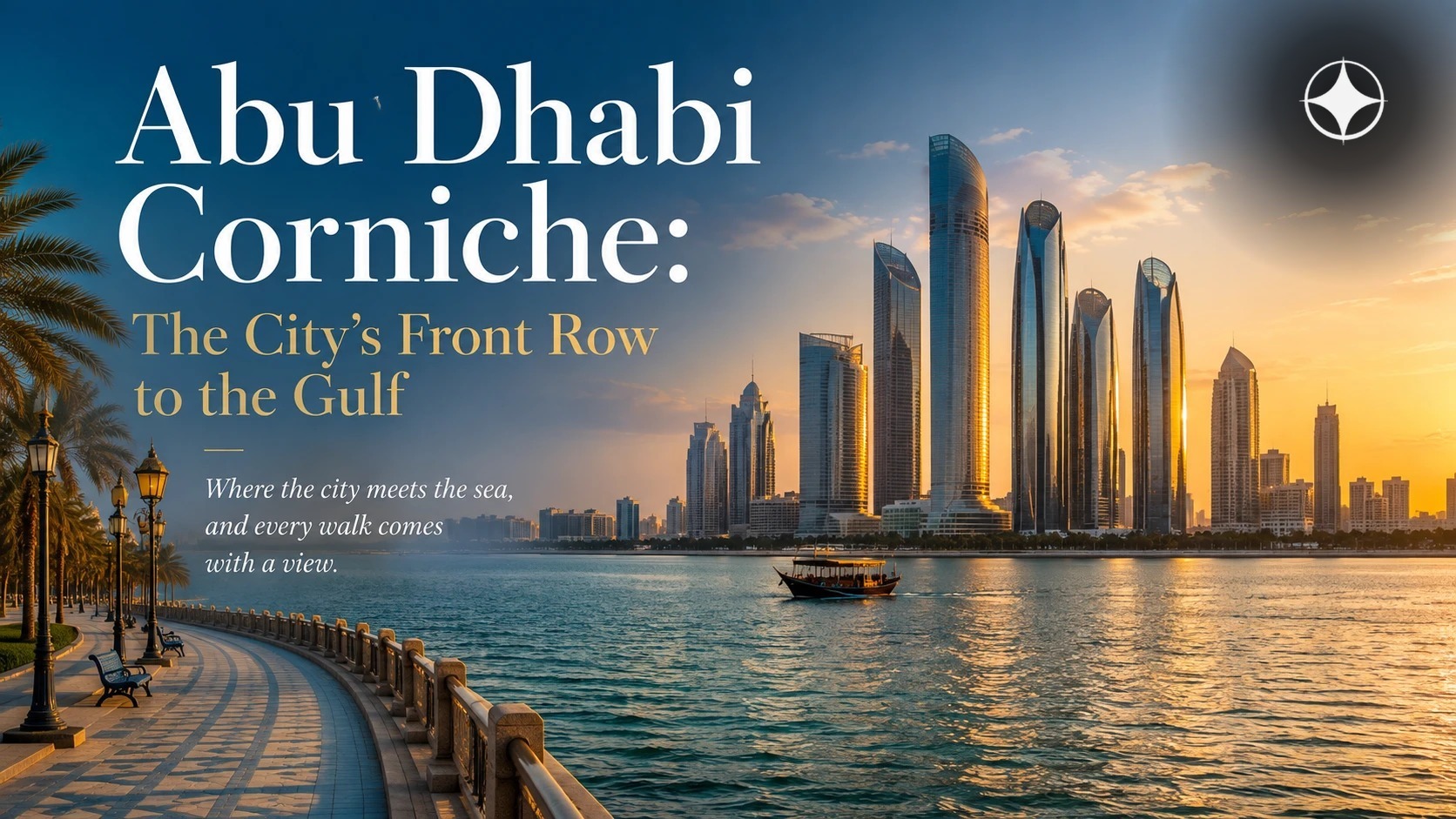
Abu Dhabi Corniche is one of the places where the capital’s relationship with the sea is most visible. Stretching for roughly eight kilometres, the waterfront combines landscaped gardens, promenades, beaches and uninterrupted views across the Gulf. It is designed for a simple rhythm of everyday life: walking, running, cycling, swimming, meeting for coffee or staying long enough to watch the evening light change.
How the shoreline changed
The Corniche has evolved considerably over the decades. In the 1970s, the waterfront was more functional, closely connected to boats, harbour activity and the early development of Abu Dhabi. The capital was still taking shape, and the water’s edge was a working boundary rather than a place to spend an afternoon.
As the city expanded, land reclamation reshaped the coastline. Roads and pedestrian routes were extended, beaches and parks were introduced, and what had once been the edge of the island gradually became a major public space — while still feeling like a genuine shoreline rather than simply an urban boulevard.
Talk to a licensed broker: 📲 +971 50 120 32 64 on WhatsApp, @dubai_oleg on Telegram
The waterfront today
Separate routes accommodate pedestrians and cyclists, which removes most of the friction between them across an eight-kilometre stretch. Landscaped gardens, shaded benches, cafés, restaurants and children’s areas make it easy to spend several hours here without leaving.
The atmosphere changes throughout the day. Early mornings belong to runners, cyclists and swimmers taking advantage of cooler temperatures — in the UAE climate, that is a defining factor for the whole city’s schedule. Later, families arrive with beach bags, children head toward the water, and groups gather around cafés and public seating areas.
Corniche Beach: zones and facilities
Corniche Beach extends for around two kilometres, with pale sand and relatively calm turquoise water. The bay is sheltered from heavier surf here, which makes it comfortable for families with young children.
The beach is divided into different sections: Al Sahil at Gate 4 is suited to individuals and larger groups, while areas around Gates 2 and 3 have a stronger family focus. That kind of zoning is uncommon for a city beach, and it works precisely because the sections are physically spread along the shoreline.
Facilities include showers, changing rooms, cabanas, sun loungers and umbrellas for hire, alongside food options, shaded areas and playgrounds. The infrastructure is designed to make a full beach day relatively straightforward — no special preparation or a car full of equipment required.
Views: Lulu Island, the Breakwater and the UAE flag
The views are an important part of the experience, and they work in several directions at once. Across the water sits Lulu Island, an artificial island directly opposite the promenade. The Breakwater curves outward near Marina Mall. Boats and jet skis move across the Gulf, and the enormous UAE flag rises above the shoreline on one of the country’s tallest flagpoles.
Nearby, Heritage Village introduces a small but meaningful glimpse of Abu Dhabi’s earlier history into an otherwise modern cityscape: a reconstructed traditional village showing what life on this coast looked like before the oil era. The contrast between it and the skyline behind is essentially the city’s whole history in one frame.
By late afternoon, the character of the Corniche changes again. The skyline begins reflecting the lowering sun, the temperature becomes more comfortable and the promenade grows busier. It is the hour both residents and visitors specifically come for.
Why it matters for the city
That combination explains much of the Corniche’s appeal: sea, beach, gardens and towers all occupy the same landscape, turning Abu Dhabi’s waterfront into both a recreational destination and part of everyday city life — somewhere people go before work and again after it.
For the property market and the hospitality industry, it is an instructive case. A well-designed public waterfront changes how an entire district is perceived: it extends visitor dwell time, supports demand for homes and hotels with water views, and turns the coastline into an asset for the whole city rather than only for front-row owners. The Corniche shows that a coastal public space can be civic infrastructure and a headline attraction at the same time.
Video on this topic
The same subject on the English channel — each clip has a written version of its own.
 15:43Nobu in Ras Al Khaimah and Abu Dhabi: why the RAK one is the more interesting asset10 December 2023
 15:37Abu Dhabi property investment: Saadiyat Island and the Aldar launch numbers16 February 2023
 8:01Island Park at Dubai Creek Harbour: an Emaar tower that is almost finished9 August 2024
 13:04Seven Palm on Palm Jumeirah: an infinity pool, a rooftop bar and a hotel underneath8 May 2024
 13:08Two-bedroom apartments in Mina Rashid: reading the layouts properly10 October 2023

In the news
Other write-ups on the site about the same thing.
Yas Point: Aldar to build the last coastal cluster on Yas Island for AED 6bn
The final waterfront plot on an island that already has a Formula 1 circuit, theme parks and a mall. What it means to buy into the closing phase of a fully formed destination.
Marsa Al Saadiyat: the final phase of Saadiyat Island, at AED 100bn
The concluding part of the island’s master plan — 6.4 million square metres, the largest marina in Abu Dhabi, hotels and culture. What is significant is not the scheme but that an entire island is being completed.
Lulu Island Abu Dhabi: Eagle Hills takes on 400 hectares off the Corniche — what is known in September 2026
Eagle Hills has confirmed it is developing Lulu Island, a 400-hectare reclaimed island 500 m off the Corniche. No masterplan or prices yet, but machinery is on site. What is known, what is not, and why early "reservations" are not purchases.
UAE's New Oases: How Dubai and Abu Dhabi Are Turning the Desert Green
Dubai ecotourism and green communities: Al Layan Oasis in Al Marmoom, Expo Valley Nature Reserve at Expo City Dubai, Hudayriyat Island in Abu Dhabi and Kalba in Sharjah. What is being built, when it opens and why nature is becoming part of UAE real estate.
Saadiyat Beach Ranks in the World's Top 20: Abu Dhabi Beats Famous Resorts
Saadiyat Beach in Abu Dhabi is No. 19 in The World's 50 Best Beaches 2026. Why Saadiyat Island made the list of the best beaches in the world, and how the Louvre, a marine reserve and luxury resorts are turning it into Abu Dhabi's main tourism hub.
Flying taxis hit UAE skies in 2026: DXB to the Palm in 12 minutes, Abu Dhabi to Dubai in under half an hour
Dubai and Abu Dhabi air taxis start commercial flights in 2026: the first vertiport at DXB is finished and the capital has priced its routes. Where the vertiports are, flight times, what an Abu Dhabi to Dubai air taxi will cost and what it means for property.